
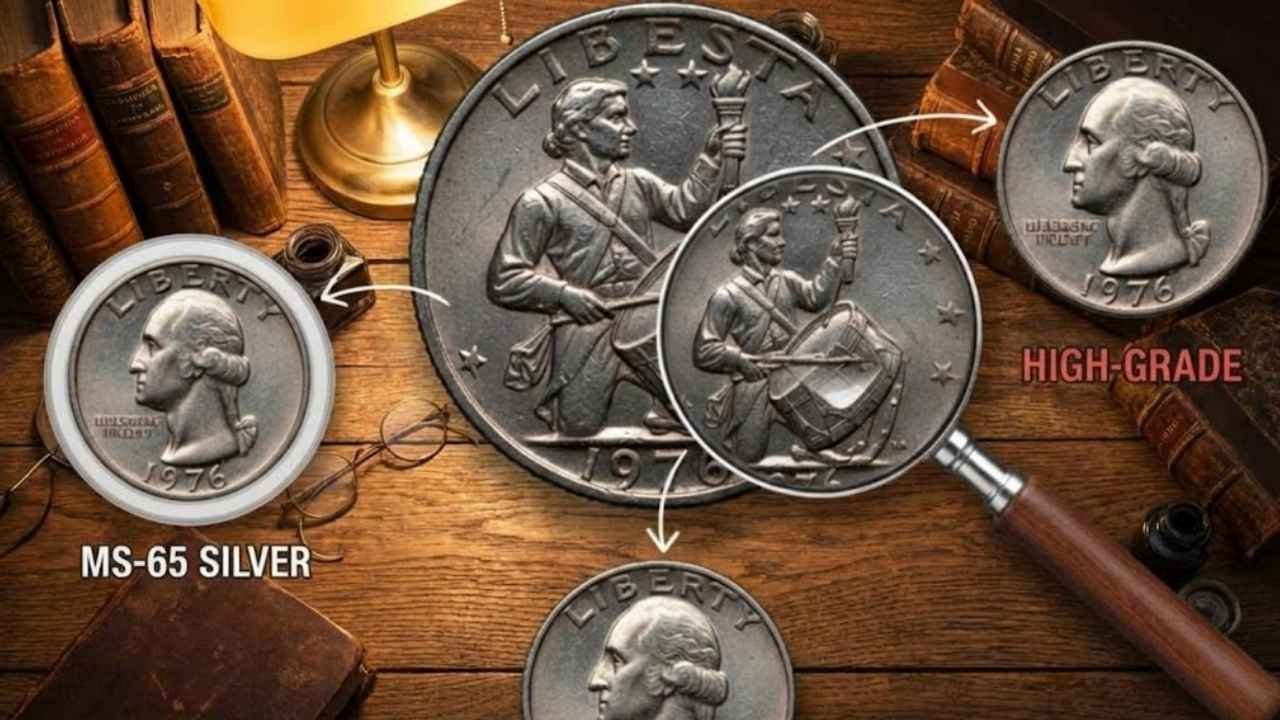
It is currently December 19, 2025, and you may have encountered viral headlines claiming that a 1976 Bicentennial Quarter has sold for $3 million.
As your thought partner, I want to clarify the market reality: There is no verified sale of a 1976 Bicentennial Quarter for $3 million. Most articles citing this figure are based on unverified “prototype” rumors or AI-generated clickbait. However, there are legitimate rare varieties and errors that have sold for five-figure sums (up to $19,000+).
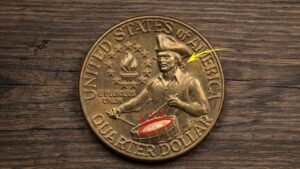
Here is what you actually need to look for in your change.
The Real “Big Money” Varieties
While millions were minted, only a few specific types command high premiums.
A. The 1976-S Silver Business Strike (MS69)
The San Francisco Mint produced 40% silver versions for collectors. While most are common, a “business strike” (not a proof) in near-perfect condition is the current record holder.
- Identification: Look for the “S” mint mark and a solid silver edge (no copper stripe).
- Highest Sale: A PCGS-graded MS69 specimen sold for approximately $19,200.
- Why it’s rare: Most uncirculated silver coins have tiny scratches; an MS69 is virtually flawless.
B. The 1976-D Doubled Die Obverse (DDO)
This is the most famous error for this year. It occurs when the coin is stamped twice, causing a “ghosting” or doubling effect.
- Identification: Look for clear doubling on the letters of “LIBERTY” and “IN GOD WE TRUST.”
- Value: In high grades (MS66+), these can reach $8,000 to $10,000. Circulated versions are worth $20–$100.
Major Mint Errors to Watch For
Errors are accidents during production that make a coin unique. These are the “lottery tickets” of coin hunting.
- Struck on Wrong Planchet: Occasionally, a quarter design was stamped onto a dime or nickel blank. These coins will be smaller, the wrong color, or have “clipped” designs. Value: $1,000 – $5,000+.
- Off-Center Strike: If the coin wasn’t centered in the press, part of the design is missing, leaving a blank crescent. Value: $200 – $1,000 depending on the severity.
- Clipped Planchet: A curved “bite” is missing from the edge of the coin. Value: $50 – $150.
2025 Value Expectation Table
| Variety / Error | Mint Mark | Finish | Estimated Value (Top Grade) |
| 40% Silver Uncirculated | S | Business Strike | $19,200 |
| Doubled Die Obverse | D | Clad | $8,400 |
| Deep Cameo Proof | S | 40% Silver | $2,760 |
| Standard Clad (Flawless) | P or D | MS68 Grade | $1,500 – $5,000 |
| Standard Circulated | P or D | Any | $0.25 (Face Value) |
Export to Sheets
How to Spot a Rare Quarter at Home
- Check the Mint Mark: Find the small “S” or “D” to the right of Washington’s ponytail. If there is no letter, it was minted in Philadelphia.
- The “Silver” Test: Look at the edge of the coin. If you see a brown copper stripe, it is a common clad coin. If it is solid silver/white, it is the 40% silver version.
- Magnify the Date: Use a 10x jeweler’s loupe to look at the “1776–1976.” If the numbers look “thick” or doubled, it could be a Doubled Die.
- Weigh the Coin: A standard quarter weighs 5.67g. A silver Bicentennial quarter weighs 6.25g.
Summary: Don’t Quit Your Day Job (Yet)
The chance of finding a $19,000 coin in your pocket is very slim because most high-value coins were pulled from circulation decades ago. However, uncirculated rolls or old collections still hold these treasures.