
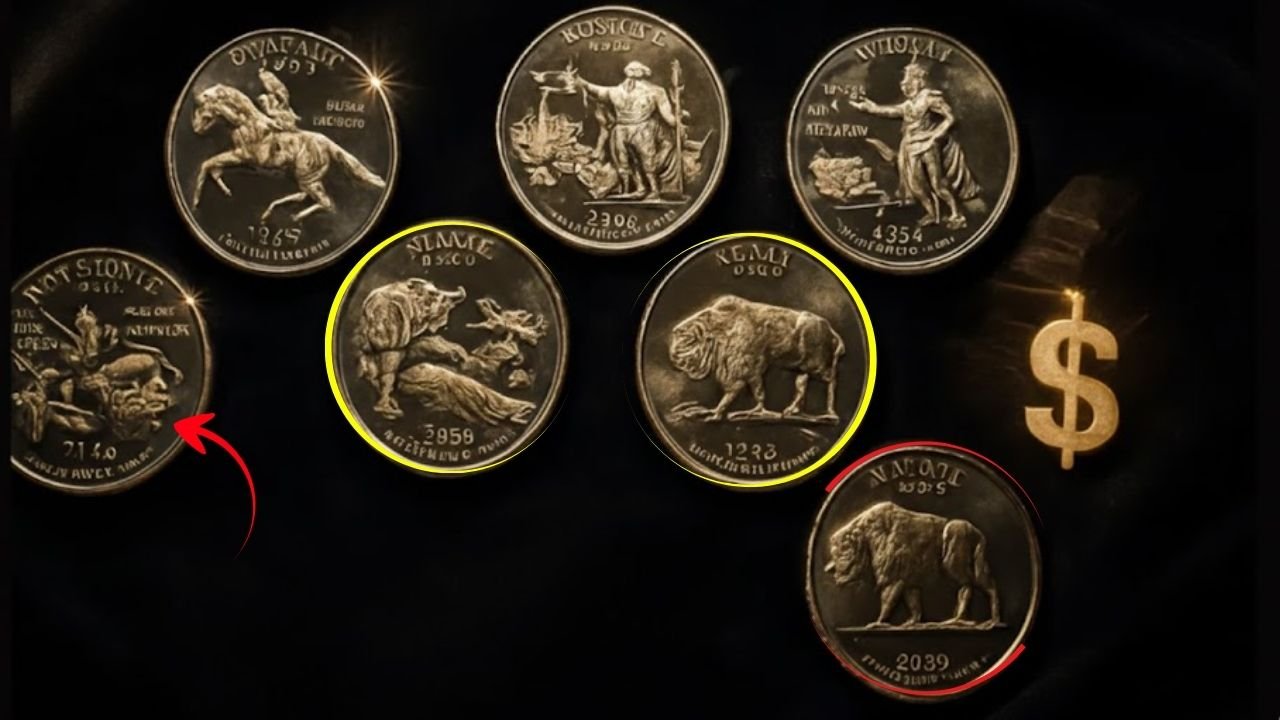
The 50 State Quarters program (1999–2008) is one of the most successful in U.S. history, but most people don’t realize that some of these 25-cent coins are actually worth a small fortune. While billions were minted, a few “lucky” mistakes at the Mint created rare varieties that collectors are desperate to find in 2025 and 2026.
If you have a jar of quarters, keep a magnifying glass handy. Here are the top 7 rarest state quarters that could be worth thousands of dollars.
2004-D Wisconsin “Extra Leaf” Quarter
This is the most famous error in the entire series. On the back of the Wisconsin quarter, next to the corn stalk, a small extra leaf appears that was never part of the original design.
- The Varieties: There are two types—the “High Leaf” (near the top) and the “Low Leaf” (near the bottom).
- Why it’s rare: No one knows exactly how they were made, but they only came from the Denver Mint.
- 2025 Value: A perfect “MS67” grade coin has sold for over $6,000. Even circulated versions can fetch $50 to $150.
1999-P Delaware “Spitting Horse”
The first state quarter ever released also has one of the coolest errors. A die crack (a small break in the metal stamp) created a raised line on the back of the coin.
- How to Identify: Look at the horse’s mouth. It looks like a thin line of “spit” is coming out.
- 2025 Value: High-grade specimens can reach $500 to $2,000+, though smaller cracks are worth around $20.
2005-P Kansas “In God We Rust”
This “grease error” happened when the letter “T” in the word “TRUST” was filled with machine grease, preventing it from being stamped onto the coin.
- How to Identify: The motto on the front clearly reads “IN GOD WE RUST.”
- 2025 Value: A very clear, clean version of this error can sell for $100 to $500 depending on how pristine the coin looks.
2005-P Minnesota “Extra Tree”
Because of a “doubled die” error, some Minnesota quarters appear to have an extra spruce tree in the background.
- How to Identify: Look at the trees to the right of the lake on the back. There are over 50 different versions of this error, but the ones with a clear, separate “ghost tree” are the winners.
- 2025 Value: Small errors are worth $5, but major “Extra Tree” varieties in top condition sell for $100 to $1,500.
2000-P New Hampshire “Striking Error”
New Hampshire quarters have been found with various striking errors, including coins struck on the wrong metal or “off-center” strikes.
- How to Identify: If the coin is missing part of its design or looks lopsided (off-center), it is a rare strike error.
- 2025 Value: Major off-center strikes (more than 25%) can be worth $500 to $2,500.
2004-P Texas “Grease Strike-Through”
Similar to the Kansas error, some Texas quarters have large parts of their design missing because grease got between the stamp and the coin.
- How to Identify: Look for quarters where the “Lone Star” or parts of the state outline look smooth or blurry compared to the rest of the coin.
- 2025 Value: Significant grease errors are currently trending between $100 and $400.
1999-P Georgia “Experimental Planchet”
When the State Quarter program began, the Mint tested different metal “blanks” (planchets) to see what looked best. A few Georgia quarters were accidentally struck on these experimental metals.
- How to Identify: These coins have a distinct yellow or gold tint and weigh slightly different than a regular quarter. They do not have the typical copper-colored edge.
- 2025 Value: These are ultra-rare and can sell for $3,000 to $10,000 at major auctions.
State Quarter Error Value Table (2025-2026)
| State & Year | Error Name | Location | Estimated Value |
| Wisconsin 2004-D | Extra High/Low Leaf | Back (Reverse) | $150 – $6,000 |
| Delaware 1999-P | Spitting Horse | Back (Reverse) | $20 – $2,000 |
| Kansas 2005-P | “In God We Rust” | Front (Obverse) | $50 – $500 |
| Minnesota 2005-P | Extra Tree (DDR) | Back (Reverse) | $10 – $1,500 |
| Georgia 1999-P | Experimental Metal | Entire Coin | $3,000 – $10,000 |
| New Hampshire 2000 | Off-Center Strike | Edge/Design | $100 – $2,500 |
| Texas 2004-P | Grease Strike | Back (Reverse) | $50 – $400 |
Frequently Asked Questions (FAQ)
Q: Can I find these in my normal pocket change?
A: Yes! Unlike silver quarters (which were stopped in 1964), these state quarters are still in circulation. People spend them every day without realizing they are rare.
Q: How do I know if my coin is in “Mint State”?
A: “Mint State” (MS) means the coin has no wear and tear from being spent. It still has its original shiny “luster.” The higher the MS number (up to 70), the more it is worth.
Q: Should I clean a quarter if it looks dirty?
A: NO. Never clean a coin. Even using a soft cloth can leave tiny scratches that professional graders will see, which can cut the value of your coin in half.
Conclusion
The hunt for rare state quarters is one of the easiest ways to start coin collecting. By simply checking your change for “extra leaves,” missing letters, or “spitting horses,” you could turn a few cents into thousands of dollars. Always keep your rare finds in a soft plastic flip or a small bag to protect their condition!