
1776–1976 Quarter Dollar Value Guide Chart: Are you wondering if that old 1776-1976 quarter in your pocket change could be a hidden gem? These special coins, also known as Bicentennial quarters or Drummer Boy quarters, were made to celebrate America’s 200th birthday in 1976. They feature a unique design with dates from 1776 to 1976. While most are worth just 25 cents, some rare versions with errors or in top condition can sell for thousands of dollars. In this guide, we’ll break down their history, designs, values, and tips to spot valuable ones. Whether you’re a beginner collector or just curious, you’ll learn how to check your coins for big money potential.
History of the 1776-1976 Bicentennial Quarter
The United States wanted to mark the 200th anniversary of the Declaration of Independence in a big way. Back in 1971, lawmakers passed rules to create special coins for the event. These included quarters, half-dollars, and dollars with new designs. Production started early in 1975 to make sure there were enough coins and to stop people from hoarding them, thinking they’d become super valuable right away.
Unlike the 100th anniversary in 1876, which only had medals, the 1976 celebration got actual circulating coins. The U.S. Mint held a nationwide contest in 1973 to pick the best designs. Over 800 entries came in, and winners got $5,000 each. This made the coins a fun piece of American history, tying back to the Revolutionary War era.
Design Features of the Bicentennial Quarter
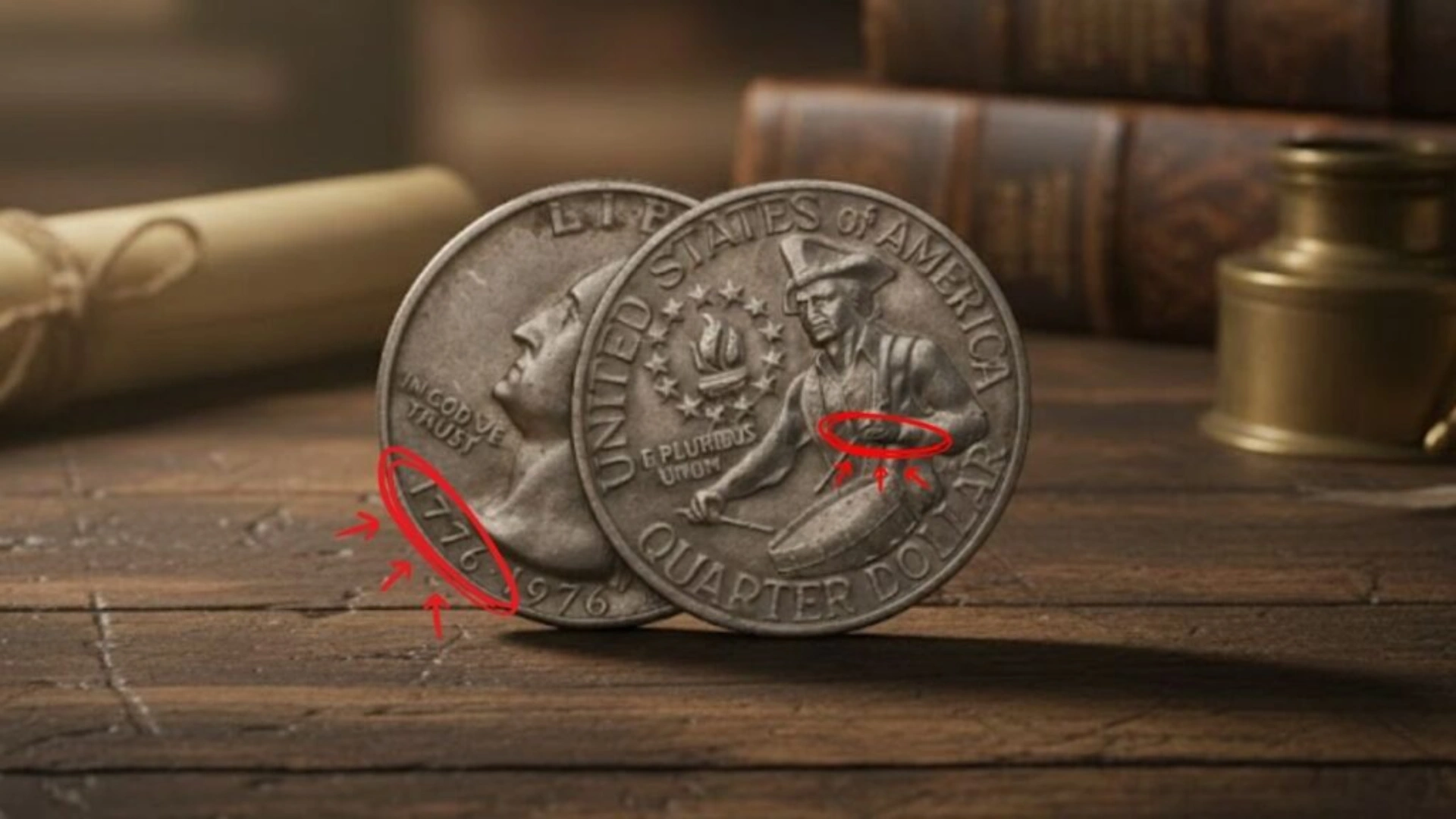
The front side (obverse) shows George Washington facing left, just like regular quarters. It has words like “LIBERTY” at the top, “IN GOD WE TRUST” on the left, and the double date “1776-1976” at the bottom. If there’s a mint mark (a small letter showing where it was made), it’s on the right side of Washington’s hair.
The back side (reverse) is what makes it special. It features a colonial drummer boy playing a drum, with a torch and 13 stars around it (for the original 13 states). The words “UNITED STATES OF AMERICA” curve at the top, “QUARTER DOLLAR” at the bottom, and “E PLURIBUS UNUM” (which means “out of many, one” in simple terms) in the middle. The designer’s initials “JLA” are tiny near the drummer’s arm. This replaced the usual eagle design, making it easy to spot.
Most coins are made of copper-nickel layers (cupronickel-clad, meaning a mix of copper and nickel for durability), but some special ones have 40% silver.
Mintage Numbers: How Many Were Made?
The U.S. Mint produced over 1.6 billion of these quarters to meet demand. They came from three places: Philadelphia (no mint mark), Denver (D mark), and San Francisco (S mark).
Here’s a quick table of mintage figures:
| Mint Location | Type | Number Produced |
|---|---|---|
| Philadelphia | Regular (copper-nickel) | 809,784,016 |
| Denver | Regular (copper-nickel) | 860,118,839 |
| San Francisco | Copper-nickel proof | 6,995,180 |
| San Francisco | Silver proof | 3,998,621 |
| San Francisco | Silver uncirculated | 4,908,319 |
Proof coins are shiny specials for collectors, made with extra care. Uncirculated means they’re fresh from the mint without wear.
Value Guide and Price Chart for 1776-1976 Quarters
The value depends on condition (how new it looks), mint location, and if it’s silver or has errors. Grading services like PCGS or NGC rate them from MS (mint state, uncirculated) or PR (proof) with numbers like 65-70 for top quality. Circulated ones (used in everyday money) are usually worth face value, about $0.30 to $0.85.
Philadelphia Mint Quarters
These have no mint mark and were made in huge numbers. In average condition, they’re cheap, but top grades fetch more:
- MS65: $6-$10
- MS66: $15-$40
- MS67: $35-$70
- MS67+: Up to $2,350
Denver Mint Quarters
Marked with “D,” these often hold up better over time:
- MS68 (highest grade): $3,220-$6,463
San Francisco Mint Quarters
These are collector specials with “S” mark:
- Copper-nickel proof (PR69 Deep Cameo): $7-$50
- Silver proof (PR70): Up to $288
- Silver uncirculated (MS69): $5,060-$19,200 (very rare, only a few known)
Value Table Summary (Approximate 2024 Prices):
| Condition/Grade | Philadelphia | Denver | San Francisco (Silver) |
|---|---|---|---|
| Circulated | $0.30-$0.85 | $0.30-$0.85 | N/A |
| MS65/MS66 | $6-$40 | Similar | N/A |
| MS67+ | $1,821-$2,350 | N/A | N/A |
| MS68/MS69 | N/A | $3,220-$6,463 | $5,060-$19,200 |
| Proof (PR70) | N/A | N/A | $79-$288 |
Always check current auction prices, as they can change.
Rare Errors and Varieties That Boost Value
Errors happen during minting and can make coins super valuable. Here are key ones:
- Doubled Die: Letters or images look doubled due to a die mistake. A 1976-S version sold for $8,400.
- Overstruck on Wrong Planchet: Coin struck on a dime instead of quarter blank. One proof example went for $12,000.
- Struck Through Object: Something like cloth got in the way, leaving marks. One sold for $881.
- Off-Center Strike: Design not centered, or missing parts.
- No Mint Mark on Silver: Rare rumor, but unconfirmed.
Look for these under a magnifying glass. Professional appraisal is key for errors.
How to Identify and Collect Valuable Bicentennial Quarters
Start by checking your change or old jars for these coins. Use a coin loupe (magnifying tool) to spot errors. Store them in protective holders to keep condition high. Join collector groups or apps for tips. Remember, silver versions feel heavier and were sold in sets.
FAQ: Common Questions About 1776-1976 Quarters
How much is a 1776-1976 quarter worth today? Most are 25 cents, but rare ones can reach $19,200 or more.
Are there 1975 quarters? No, because minting focused on the new design early.
What makes a bicentennial quarter rare? High grades like MS69, silver types, or errors like doubled dies.
How do I know if my quarter has an error? Check for doubling, off-centers, or unusual strikes. Get it graded.
Are no mint mark quarters valuable? Philadelphia ones have no mark and can be worth up to $2,350 in top shape.
Where can I sell my bicentennial quarters? Try auction sites like eBay, coin shops, or services like Heritage Auctions.
Conclusion: Start Hunting for Your Treasure
The 1776-1976 Bicentennial quarter is more than just money—it’s a slice of American history that could be worth a fortune. With over a billion made, they’re common, but the rare errors and perfect-condition pieces turn them into collector’s dreams. By understanding values, designs, and mistakes, you can discover hidden value in everyday coins. Grab your magnifying glass and start checking—your next big find might be in your wallet! Always consult experts for appraisals to get the best price. Happy collecting!